

What the Epstein Interlochen Witness Told the FBI in Her Second Interview
Three months after her first FBI interview, the woman from Part One sat down with investigators again. The questions had changed. Her account had not.

Your subscription truly helps share this work. Thank you. Primary sources are always included and this work always posts free.
The second set of notes, dated December 17, 2019 (EFTA00276901 to EFTA00276918; FD-302, Serial 3509-005, Case 50D-NY-3027571), goes back over the same childhood split between Sweden and Florida, the same brothers, the same summers at Interlochen, the same years spent moving through Epstein’s homes in Palm Beach, New York and New Mexico.
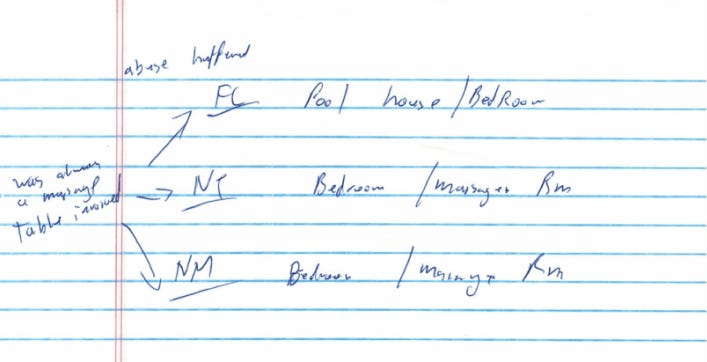
She testified at Maxwell’s 2021 trial that she has two brothers, and that both went with her to Interlochen the first summer. The FD-302 in this section discusses one of them specifically. Investigators were no longer asking only what happened to her. They wanted to know who knew, who stayed quiet, what Maxwell’s role had actually been, and who could still corroborate the machinery around her.
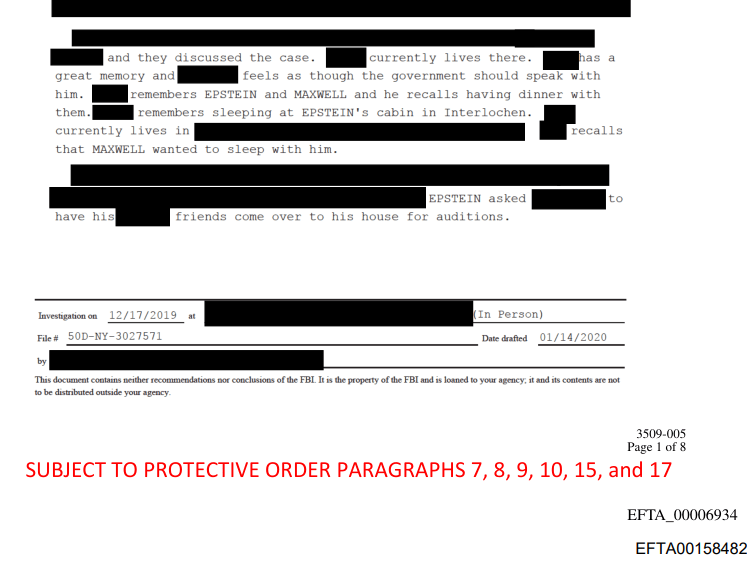
What she gave them during this interview was the structure of what happened.
She Did Not Tell Her Mother
The first part of the second interview turns away from Epstein’s famous friends and back toward family.
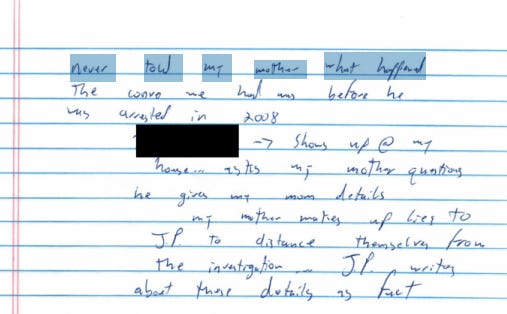
She said she and her mother had never really talked about the abuse. Once, before Epstein’s 2008 arrest, her mother told her she hadn’t known what was happening. Her mother did remember Epstein and Maxwell: dinners with them, a visit to Palm Beach, staying at Epstein’s cabin near Interlochen. She remembered enough of him to have once called him the children’s godfather. What she never knew was what happened once her daughter was alone with him.
Her brother’s memory of Epstein came up too. She said he had a strong memory of the period and thought the FBI should talk to him directly.
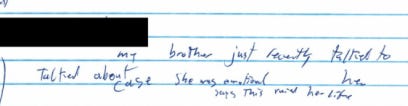
He remembered the same dinners, the same cabin. He also recalled Maxwell wanting to sleep with him, and Epstein asking him to bring friends over for “auditions,” echoing the request described in Part One that sent girls from Juilliard to Epstein’s mansion, ending when they ran back out of the house screaming.
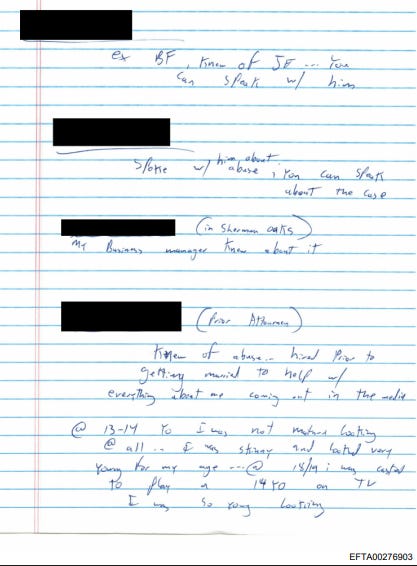
She also mentioned an ex-boyfriend from when she was eighteen or nineteen. He knew about Epstein but not the abuse. Mostly he stayed away because Epstein was possessive of her. She told the FBI she’s still in touch with him, and that he knows she’s spoken with prosecutors.
She Did Not Look Older
Part One only touched on this. The second interview makes it explicit.
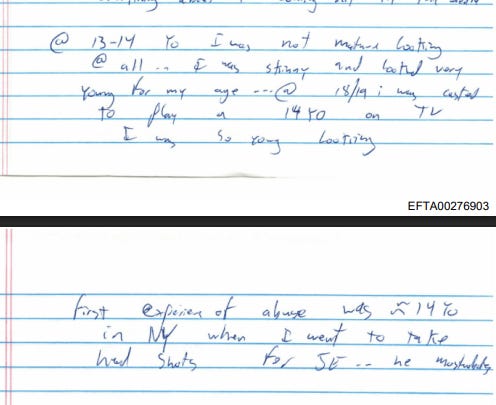
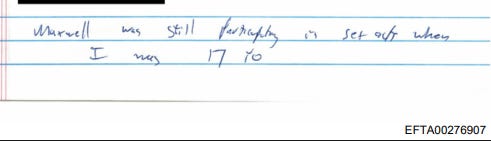
At thirteen and fourteen, she said, she “was not mature looking at all.” She was thin and looked young even for her age. Her first real experience of abuse came around fourteen, in New York, during what was framed to her as a head-shot session, the same session from Part One where Epstein masturbated in front of her and she felt paralyzed. She placed part of this timeline in the summer of 1997, when she would have been sixteen or seventeen, one of the only firm dates she gave investigators.
Her account makes it considerably harder to argue that the adults around Epstein, including at Mar-a-Lago, could have reasonably assumed she was older than thirteen or fourteen years of age.
Ghislaine Maxwell
Part One placed Maxwell’s involvement at roughly six months after the grooming started, while the witness was still fourteen years old. The second interview fills that in with more than prosecutors had gotten from the first.
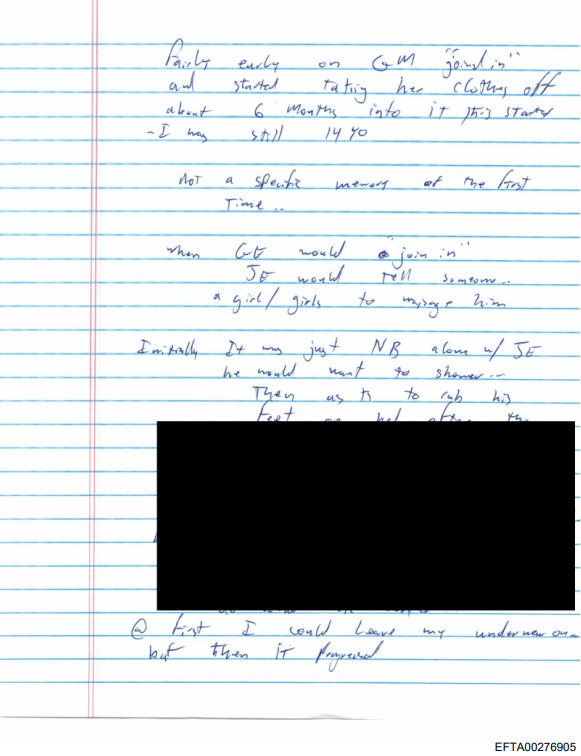
Maxwell “joined in,” she said, and began taking her clothes off around that same point. It started with foot massages, Maxwell alongside her. By sixteen, she said, she’d been trained to do what Epstein wanted without being told. She was allowed to keep her underwear on at first. That didn’t last.
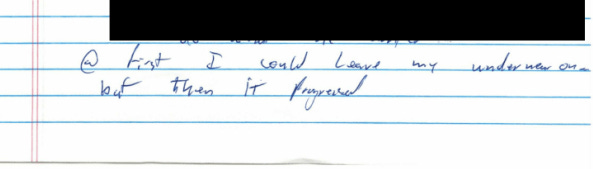
She estimated Maxwell was present for roughly 25 percent of the abuse between the ages of fourteen and seventeen, spread across Florida, New York and New Mexico. She was careful about what she could and couldn’t confirm. She remembered Maxwell present while Epstein masturbated in front of her, and present once while another woman performed oral sex on Epstein on a massage table. She wasn’t sure if Maxwell was present for every act involving a sex toy.
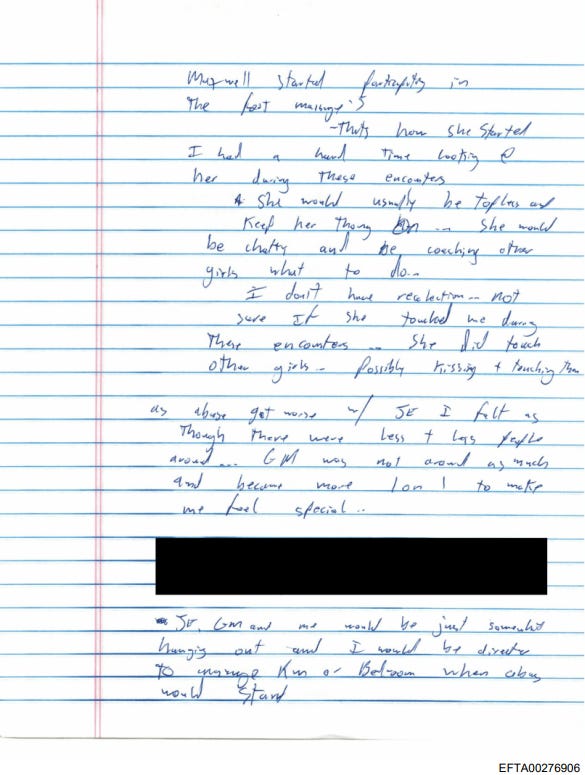
She described Maxwell as giving off a “big sister” energy that made it hard to look at her during these encounters, so she mostly avoided it, which meant she couldn’t say for certain what Maxwell did with other girls, only that she believed something happened.
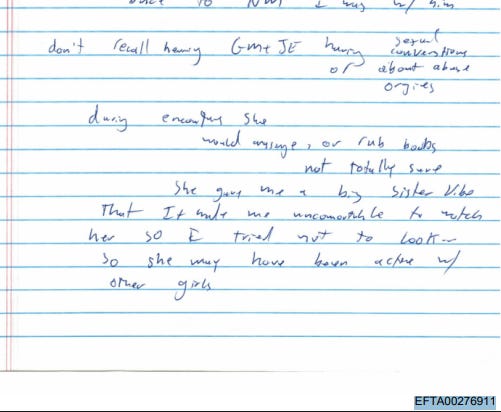
Afterward, she said, there was almost no conversation. Whatever happened stayed where it happened. She said when she was seventeen Maxwell was still participating in sex acts.
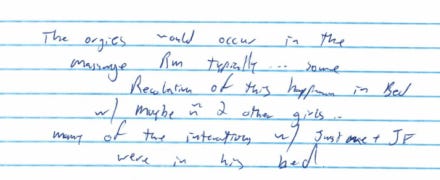
She said orgies happened in the massage room. Sometimes in Epstein’s bedroom.
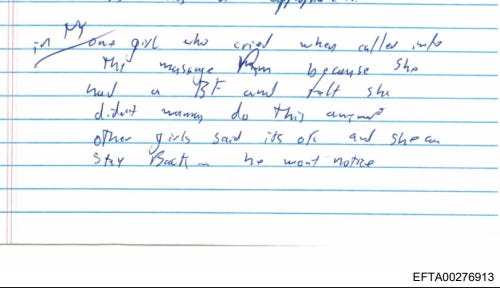
She explained how she witnessed a girl begin crying when being called into the massage room. The other girls told her to stay back and that Epstein “wouldn’t notice.”
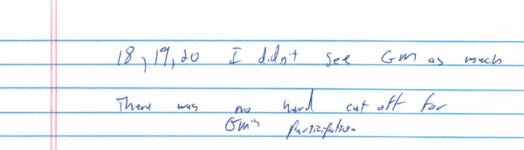
By eighteen, nineteen and twenty, she saw much less of Maxwell, though she couldn’t point to an exact date when it stopped.
The Class System
This is where Part Two stops being a continuation of one woman’s story and starts being an account of how Epstein’s operation actually worked.
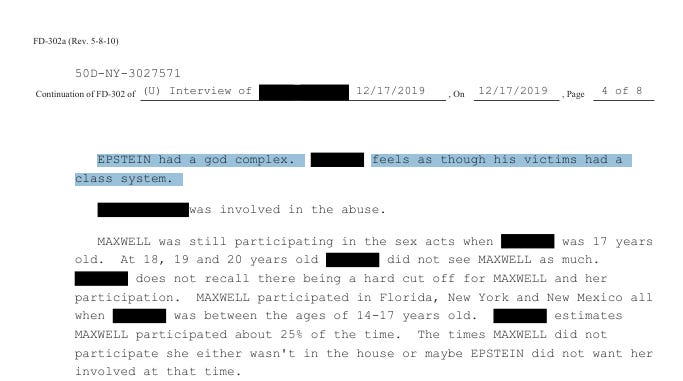
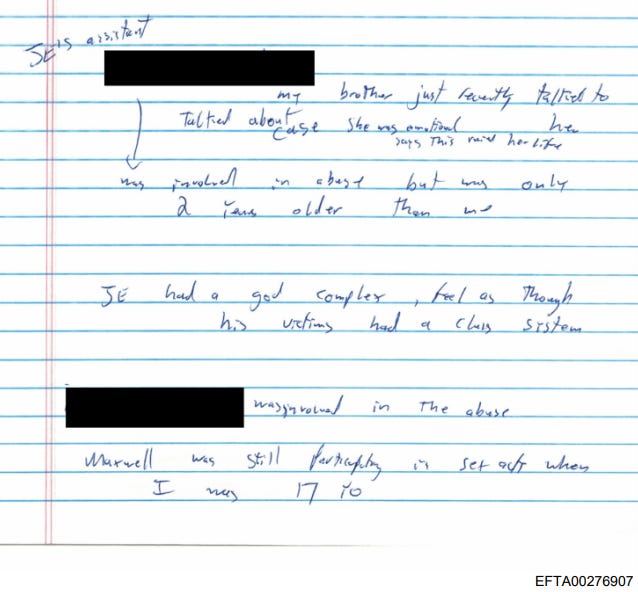
She told the FBI Epstein had “a god complex,” and that his victims existed inside what she called a class system. Around sixteen she was fat shamed. Epstein took Polaroids of her in her underwear and told her she looked heavy, the same period he and Maxwell were taking her to Victoria’s Secret to buy more of the underwear he’d had her wearing since she was thirteen.
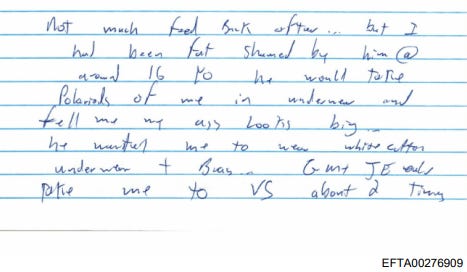
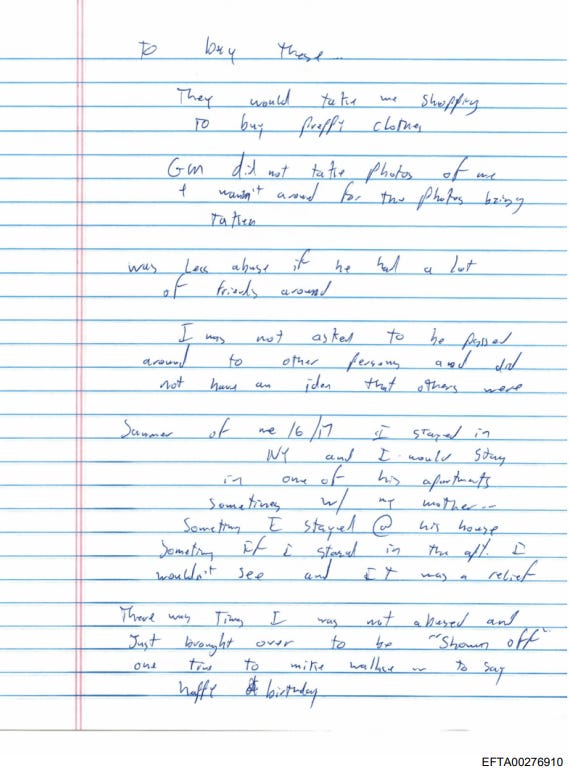
She was never asked to participate. She was instructed. She said she believed Epstein ranked girls by some system she couldn’t fully explain, beyond noticing some mattered more to him than others, and that as she got older she understood herself sliding down that list. That’s the context behind a line quoted in Part One, the one that closes her first interview: I was aging out.
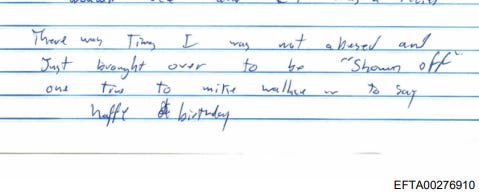
There was less abuse, she said, when Epstein had a lot of friends around. Sometimes she was brought over just to be shown off, including once to wish Mike Wallace a happy birthday,
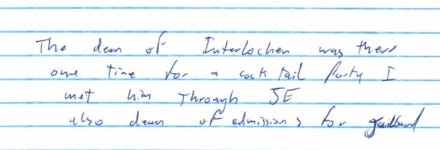
and once to a cocktail party where the dean of Interlochen was a guest, a man she noted was also the dean of admissions at Juilliard.
Untangling the Other Names
Reporting since Part One published has put more names near this story than the piece originally accounted for. None of them are her, and three different numbering systems are partly why that keeps getting confused.
NPR’s February 2026 reporting on Epstein’s donor relationship with Interlochen describes two women connected to Epstein and Maxwell through the school: the woman in this series, who gave six FBI interviews between September 2019 and September 2021 and testified against Maxwell at trial, and a second, unnamed woman who met them a few years later, had her boarding school tuition paid, and was cut off after refusing to accompany “a high profile person” to a gathering in New York.
Interlochen’s own commissioned report, from the Sanghavi Law Office, released the week of July 28, 2026, identified eight alumni believed to have had contact with Epstein, interviewed six, and found two who described physical sexual conduct. That report labels them Victim 1 and Victim 2. Those labels are the law firm’s, not the FBI’s, and they aren’t a count of how many women exist in this story.
That report says nothing about Trump. Its scope is Interlochen's own history: across the institution's full record, investigators identified 47 adults accused of sexual misconduct and collected more than 70 firsthand accounts, spanning the 1950s through the 2010s. The Epstein-related findings inside it, eight alumni contacted, six interviewed, two describing physical sexual conduct, are a small subset of that total, and they describe conduct at Interlochen, not an allegation involving Trump.
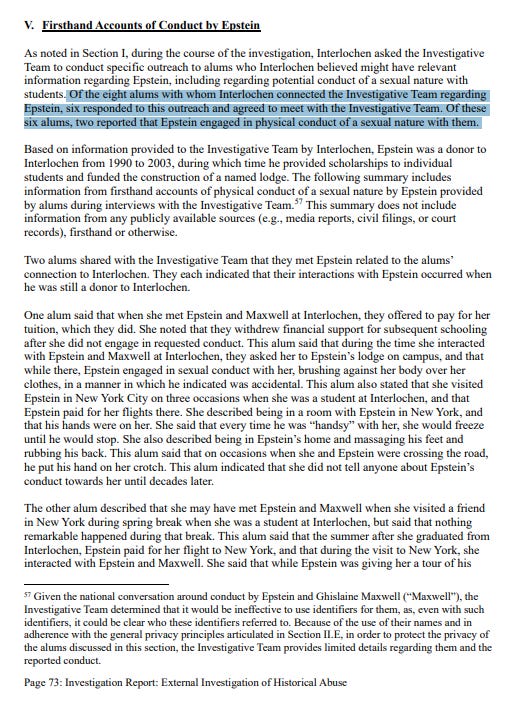
Underneath both is the FBI’s own case number, 50D-NY-3027571, inside which every interview carries its own serial. This witness holds two so far, 3509-001 and 3509-005. A shared case number does not mean a shared identity, and none of these three systems, NPR’s, Interlochen’s, or the FBI’s, translate directly into each other.
One name that has surfaced publicly is Melissa Solomon, a cellist who has said under her own name that she met Epstein and Maxwell at Interlochen at fourteen in 1997, was not abused, and cut ties after refusing to recruit Juilliard classmates and declining a meeting connected to Prince Andrew. Her account resembles NPR’s unnamed second woman in some respects. Nobody, including NPR, has confirmed they’re the same person, and this piece isn’t going to either. It stays an open question.
A second name is Nadia Bjorlin, an actress, whose connection to this story runs through her own family’s FBI record, not this witness’s file. Her mother, Fary Bjorlin, was interviewed by the FBI in Stockholm on February 5, 2020, with Swedish police present.
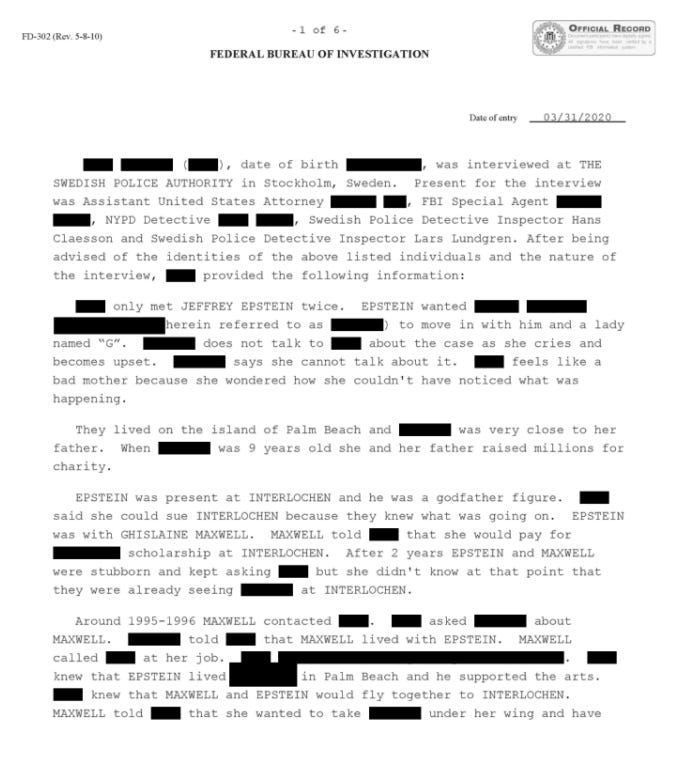
She described Epstein and Maxwell approaching her daughter at Interlochen and positioning himself as a godfather figure, then years of contact she says she tried at times to refuse, including a trip to New Mexico on Epstein’s plane when her daughter was around fifteen.
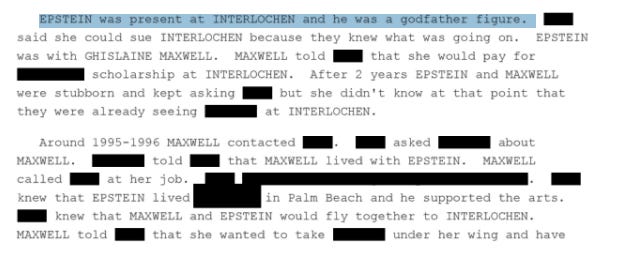
What that record does not do matters just as much as what it says. It does not describe sexual assault. It carries a serial number, 3501.021-003, that belongs to a different interview thread than this witness’s own. Bjorlin is not the plaintiff in Doe v. Indyke, Maxwell and Kahn, and no on the record statement from her or her mother has ever said otherwise.
A childhood photo of Bjorlin has also circulated online, misidentified as the plaintiff in a separate 2016 lawsuit against Trump and Epstein filed under the name Katie Johnson.
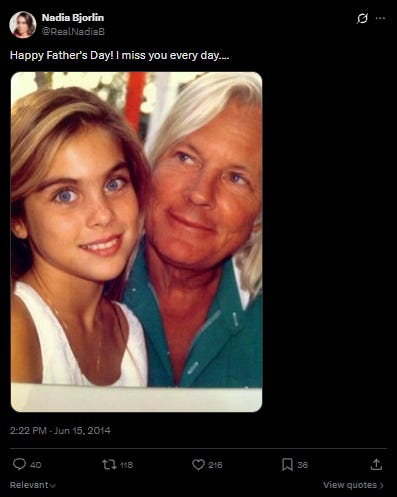
The image, of Bjorlin as a child with her father, Ulf Bjorlin, a Swedish composer and conductor who died in 1993, was cropped to remove most of him from the frame before it spread. Snopes corrected the record in March 2026. Ed Opperman, the private investigator who worked the actual Katie Johnson case, said the same thing himself, repeatedly, on X. In a December 2025 post he wrote that the circulating photo was “not her. That’s just some random meme.”
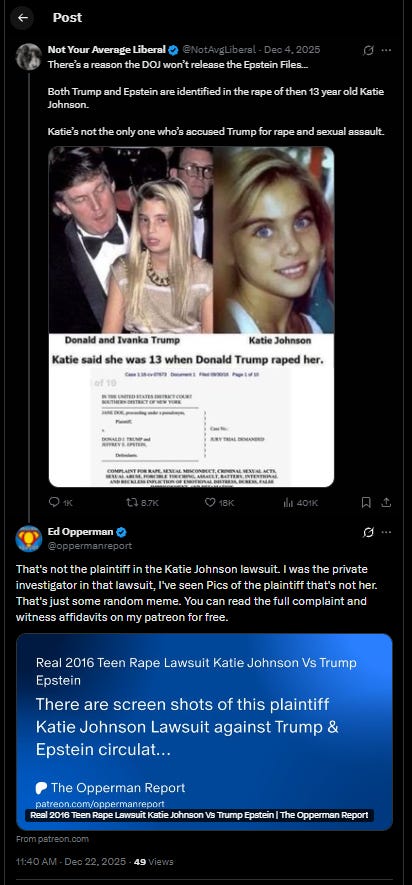
In February 2026 he put it more bluntly: “I’m the one that told you. It’s my case. I was the private investigator in the Katie Johnson lawsuit against Trump and Epstein.” In a separate reply that June, he corrected the record again and, in doing so, pointed at where some of the confusion likely started: “That’s not a pic of the plaintiff in the Katie Johnson lawsuit. The fraud charges you’re thinking of are the mother of a different 13 year old Trump raped,” a reference to an unrelated case entirely, involving neither Katie Johnson nor Bjorlin. Three separate matters, tangled into one misused childhood photo. Ulf Bjorlin himself has no documented connection to Epstein at all; the claims have only ever been about his daughter. You can read the full piece on his involvement here.
Two women, documented by NPR, met Epstein and Maxwell through Interlochen. Bjorlin’s file sits elsewhere in the same broader investigation, under her own family’s name. Pulling either the Sanghavi labels or Bjorlin’s record into this witness’s story produces the same mistake from opposite directions, a wrong count, built out of someone else’s document. She is still one woman, across at least two interviews so far, and that’s who the rest of this piece is about.
A separate case, unconnected to Interlochen, sometimes gets folded into this same conversation. A woman identified in a 2019 lawsuit as Jane Doe 4 told the FBI that Epstein abused her on Hilton Head Island, South Carolina, beginning around 1984 when she was thirteen, and that he later introduced her to Trump in New York or New Jersey, where she alleges Trump assaulted her. Her account has no documented tie to Interlochen, Sweden, or the witness this piece is about. She is a third woman entirely, not another name for anyone discussed here.
The People Investigators Could Still Ask
At the close of the second interview, she gave the FBI a list of people who might corroborate parts of her account. Not the abuse itself in most cases, but the contact around it: the calls to her house, the trips, the fact that she’d told at least one person something was wrong at the time. The list included her brother, her mother, a former boyfriend, and others tied to her schooling at Interlochen and later in New York. She said she thought she could identify some people from photographs if shown them.
None of them, on the current record, are described as witnesses to the abuse itself. What they can speak to is the architecture. The godfather framing with her mother, the cabin, the auditions offered to her brother’s friends, and the apartment Epstein co-signed.
The Case She Filed
Three months after this second interview, she filed suit as Jane Doe in the Southern District of New York: Doe v. Darren K. Indyke, Ghislaine Maxwell and Richard D. Kahn, No. 1:20-cv-00484, filed January 16 to 17, 2020.
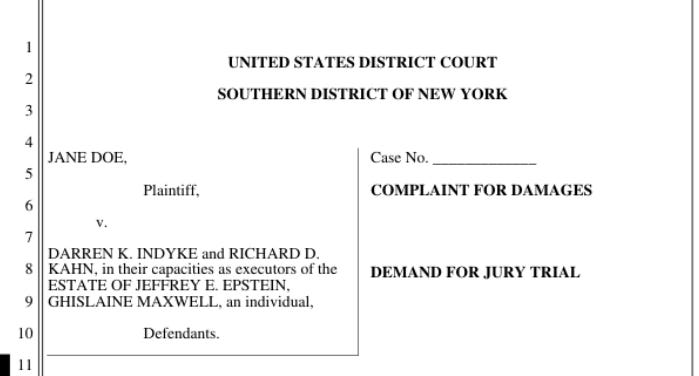
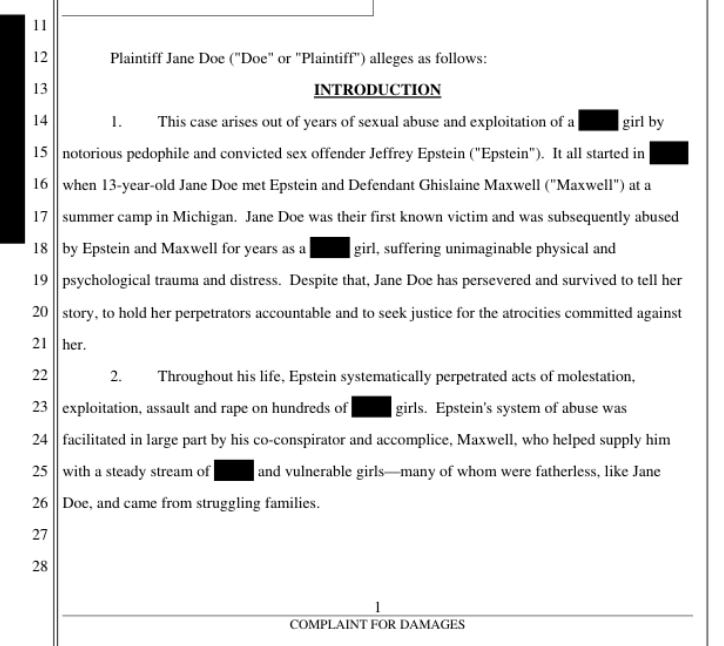
The complaint lines up with what she’d already told the FBI. She met Epstein and Maxwell at Interlochen in 1994 at thirteen. Epstein introduced her to Donald Trump at Mar-a-Lago at fourteen, elbowing him and asking, referring to her, “This is a good one, right?” Trump smiled and nodded, the complaint says, and the two men chuckled. The abuse escalated over the following years, across Palm Beach, New York, and Epstein’s ranch in New Mexico. At sixteen, Epstein moved her to New York, put her up in his own apartment, then co-signed a lease for her and her mother, and paid her tuition, the same dependency Part One described as leverage.
The complaint calls her Epstein’s “first known victim.” Press coverage at the time of filing repeated that description directly.
The case never went to trial. Judge John G. Koeltl dismissed it with prejudice in 2021 after she agreed to a settlement through the Epstein Victims’ Compensation Program, on the condition that she provide the court a signed, unredacted copy of the program’s general release. (Document 98)
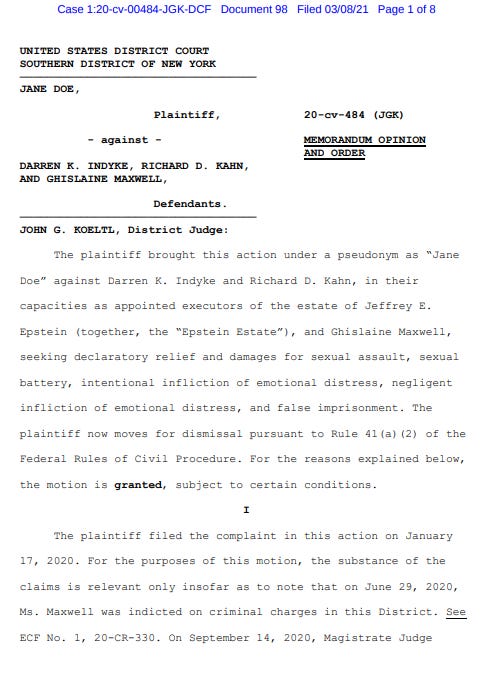
Maxwell, one of the named defendants, opposed the dismissal and fought over the terms of that release. Indyke and Kahn, the estate’s executors, did not. A dismissal with prejudice means she couldn’t refile the same claim. It isn’t a finding that what she said was false, and it isn’t one that it was proven true either. No judge ever ruled on it.
Have a tip? A lead you want to share?
This work is entirely reader supported. If you want to keep this going, subscribing is the most direct way to help. Thank you for reading and supporting this work.
Sources
EFTA00158473 to EFTA00158479, FD-302, September 19, 2019, Serial 3509-001
EFTA00158490 et seq., Complaint, Doe v. Indyke, Maxwell and Kahn, No. 1:20-cv-00484, S.D.N.Y., filed Jan. 16 to 17, 2020, Serial 3509-007 Doe v. Indyke et al., No. 1:20-cv-00484 (S.D.N.Y.), Document 98, dismissal order
NPR, "How Epstein and Maxwell used an elite Midwest arts school to prey on girls," Feb. 19, 2026
Detroit News, "Interlochen report finds 70 students accused 47 adults of sex abuse," Jul. 28, 2026
Snopes, fact check on the misidentified Bjorlin childhood photograph, March 2026
Ed Opperman, posts on X, Dec. 22, 2025 re: the misidentified photograph and the Katie Johnson case
Doe v. Trump and Epstein ("Katie Johnson"), No. 1:16-cv-04642 and No. 1:16-cv-07673, S.D.N.Y.
Fary Bjorlin interview, 2011, re: Epstein contact with Nadia Bjorlin
Last Page First, "Ed Opperman: The Investigator Behind Jane Doe Who Couldn't Keep His Story Straight," Jul. 10, 2026
Last Page First, “Katie Johnson and Jane Doe 4 Deserved Better.”
© 2025-2026 Last Page First. All rights reserved.
Amazing! Thank you!
This interlochen girl Who met Epstein & Ghislaine in 1994 when she was 13 — she was believed by federal prosecutors and a federal jury believed her as witness “Jane Doe 1” testifying in Ghislaine’s New York December 2021 trial. That jury ruled unanimously to convict Ghislaine they believed this witness.
She is credible.
This little girl was telling the truth about Ghislaine Maxwell — why in the world would she lie about meeting Donald Trump at Mar-a-Lago when she was 14? Does anybody believe there’s any legitimate reason why this little girl from an art camp in Michigan is being introduced to a predator like Donald Trump?
Are we supposed to believe Donald Trump is some artistic mentor to talented youths?
—why is a pedo like Epstein introducing this 14 yr old trafficking victim to Donald Trump at all?
Even though there is no evidence Trump assaulted this Interlochen girl, and there was only the creepy elbow-nudge introduction “this is a good one, right?”by Epstein to Trump, no one will believe that there is a legitimate reason Epstein introduced this 14-year-old girl from a Michigan summer camp to Donald Trump at Mar-aLago
.. other than- Epstein & Trump were co-conspirators in a child sex trafficking scheme.
Good work, thank you !
1994 is important for me since I am supporter of the thesis that the original Trump in fact got killed in that heli crash in 89, and then got replaced by one of his back then ?4 doubles - most probably by the one who was a British MI6 agent (before or still was).
Meaning, it was this „gentleman“ who‘s in the focus when we talk about 94.
Whether this is still the same guy as of today is a next question for it looked as if they got again several doubles of „ DT“ on stage in the past 12 months only (see Anchorage summit for instance)..