
Stanley Pottinger: 'Ever-Present, Yet Invisible In The Epstein Scandal'
Before Epstein needed a victims' lawyer, he already had Pottinger. The federal record shows why that matters.

Before Epstein became Epstein, J. Stanley Pottinger was already his business partner, already his Palm Beach neighbor, and already the kind of man who, when his old colleague got arrested for paying underage girls for sex, sat down and wrote him a letter saying it would pass. He went on to represent Epstein's victims, drew up a private list of powerful men whose surveillance footage he believed could be monetized, pushed a trafficking survivor to settle her case while she was in a wheelchair with two broken feet and a fractured spine recovering from a suicide attempt, called her turning tricks during a phone call about her own litigation, and was named an abuser in open federal court by a woman who had been his client. He appears in over 2,000 documents in the federal Epstein archive. He died on November 27, 2024, in Princeton, New Jersey, without ever being investigated — and the question a survivor asked of a sitting federal judge in 2023, whether anyone had looked into what he had done, has never received a public answer.
Your subscription truly helps share this work — thank you.
The Man Who Reinvents Himself
J. Stanley Pottinger was born in Dayton, Ohio in 1940, graduated Harvard Law in 1965, and spent the years between 1973 and 1977 as the Assistant Attorney General for Civil Rights under Nixon and Ford — inside the DOJ on the night of the Saturday Night Massacre, at Wounded Knee in 1973 as the chief federal negotiator, reopening Kent State and Jackson State, reviewing the FBI’s files on Martin Luther King Jr. in 1975. He described those years as a bizarre balancing act, trying to do liberal work in a conservative administration. His father had built one of the few insurance companies in the country that served Black clients. He credited that with shaping everything that came after.
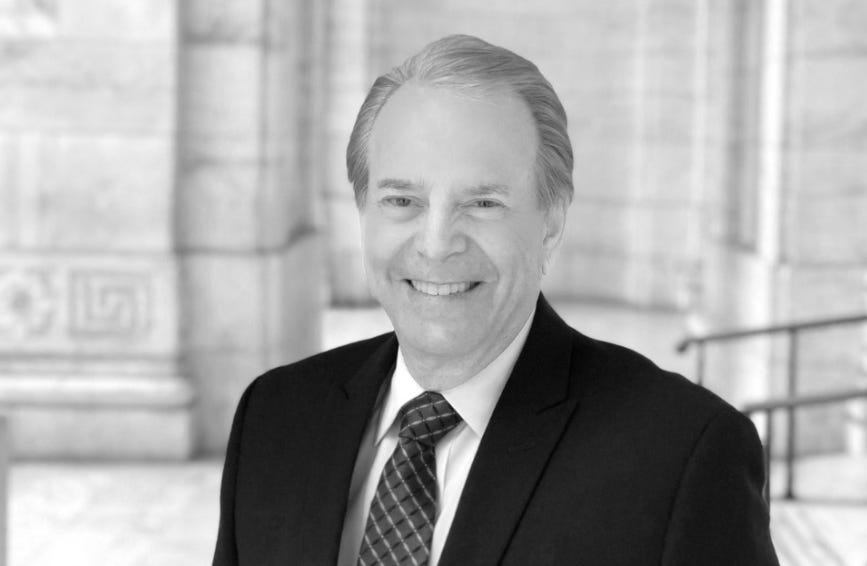
John Stanley Pottinger
By 1981 he was Epstein’s business partner, the two of them renting a penthouse at the Hotel St. Moritz on Central Park South alongside Pottinger’s brother, pitching tax-avoidance strategies to wealthy clients out of an office the broker said Epstein eventually stiffed her on the commission for. By 2016 he was Epstein’s victims’ lawyer.
Pottinger died November 27 2024, in Princeton, New Jersey. He was 84 years old. He left behind three children, including his son Matt, who served as Donald Trump’s Deputy National Security Advisor from September 2019 until January 7, 2021, when he resigned in the immediate aftermath of the Capitol insurrection. He left behind a completed but unpublished fifth novel his son described as a ‘spy thriller.’ He also left behind his name in 2,011 documents in the DOJ Epstein Files Transparency Act archive. And he left behind a question that no court, no bar association, and no federal investigator ever formally answered during his lifetime — what exactly was J. Stanley Pottinger doing in the Epstein case, and on whose behalf was he doing it?
One person who asked that question in open federal court was a survivor who had been his client. Her name is Sarah Ransome. She asked it in front of Judge Jed Rakoff, under her own name, on the record, in a sworn declaration in which his name appears 37 times. She described him as ever-present yet invisible.
That phrase is in the federal record at EFTA00144591, paragraph 30, filed under penalty of perjury in the JPMorgan class action, SDNY, October 19, 2023. And it is, as this investigation will show, about as accurate a description of J. Stanley Pottinger as the archive provides.
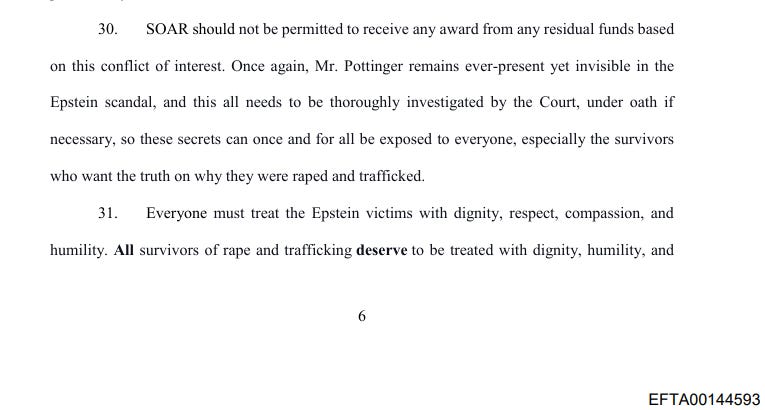
"Mr. Pottinger remains ever-present yet invisible in the Epstein scandal, and this all needs to be thoroughly investigated by the Court, under oath if necessary."
Filed under penalty of perjury.
The Penthouse on Central Park South
In 1981, Jeffrey Epstein resigned from Bear Stearns. The firm had been investigating him for insider trading — specifically, for sharing information about an upcoming IPO with a client’s girlfriend and for taking a personal loan connected to that client. The executive committee fined him $2,500 and suspended him. Rather than accept the indignity, Epstein announced he was resigning. He was ‘deeply offended’, he later wrote in a letter to colleagues. His five year career at one of Wall Street’s most aggressive firms was over — and he was, by the accounts of people who knew him then, occasionally bouncing rent checks.
What he did next has been documented in the public record for the first time only recently, and what it shows is that the first person Jeffrey Epstein turned to after the collapse of his Wall Street career was J. Stanley Pottinger — a man who had just left a senior post at the DOJ, who brought with him a rolodex built across eight years of federal civil rights enforcement, and who, it would emerge decades later, was simultaneously operating in the architecture of what would become Iran-Contra.
In 1981, after his resignation from Bear Stearns, Epstein rented a penthouse office at the Hotel St. Moritz on Central Park South with Pottinger and Pottinger's brother. The three of them pitched tax-avoidance strategies to wealthy clients, some of whom Epstein had met through Bear Stearns. The broker who helped them secure the space, Joanna Cutler, told the New York Times (which confirmed the partnership in December 2025, the first time it had ever been publicly documented) that Epstein stiffed her on the commission. The business was short lived, but the partnership had been formed, and the man at the center of it was the same man who would call Brad Edwards 33 years later offering to help represent Epstein's victims.
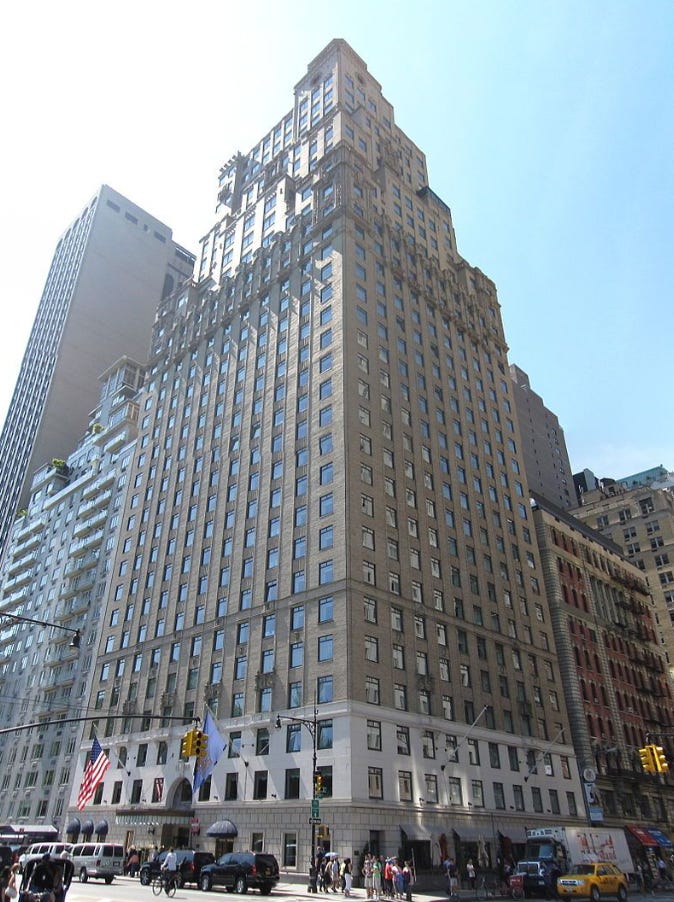
Former Hotel St. Moritz, Central Park South, New York City
The New York Times, to its credit, reported the St. Moritz detail. What the paper did not report — and what Drop Site News’s Ryan Grim documented in February 2026, drawing on FBI surveillance records and Senate Foreign Relations Committee findings — is that during the same period Pottinger and Epstein shared that penthouse, Pottinger was also serving as attorney to Cyrus Hashemi, an Iranian banker the FBI had placed under extensive electronic surveillance. The tapes, recorded across a five month span beginning in fall 1980 and continuing into the period Pottinger and Epstein shared the St. Moritz office, captured Pottinger advising Hashemi on how to circumvent the US arms embargo against Iran using phony invoices and overseas shell companies. The Senate Foreign Relations Committee later found that the CIA was involved in planning those arms deals and had met with Hashemi in Pottinger’s office — the same office Pottinger shared with Epstein. The profits from those Iran arms sales, routed through Israel as a CIA middleman, would eventually bankroll the Contra army in Nicaragua, giving the scandal its name.
This is not a conspiracy theory. The Senate Foreign Relations Committee finding is a matter of congressional record, the FBI surveillance tapes exist. The Cyrus Hashemi wiretaps are documented. The man whose office the CIA used to plan embargoed arms shipments to Iran was, at the same time, running a financial advisory business with Jeffrey Epstein from a penthouse overlooking Central Park.
The Neighbor, The Letter, And The Phone Call
By 1990, J. Stanley Pottinger had become Jeffrey Epstein’s neighbor in Palm Beach, living approximately 500 meters from the residence that Palm Beach police would begin investigating 15 years later. Both men had moved on from the St. Moritz venture to other things. Epstein had found his way to Les Wexner’s money and was building the architecture of what his victims would eventually call the network. Pottinger had moved through investment banking and a real estate venture that ended badly in the 1987 market crash, and had turned to fiction writing. His first novel, The Fourth Procedure, became a New York Times bestseller in 1995, selling over a million copies.
In 2005, Palm Beach police began investigating Epstein after a family reported he had paid a 14 year old girl for a massage. In 2006, Epstein was arrested. According to a 2006 email now in the EFTA archive, confirmed by the Wall Street Journal, Pottinger wrote to Epstein after the Palm Beach arrest expressing support and predicting the situation would pass.
The man who had spent eight years as the top civil rights enforcement officer of the United States Department of Justice, the man who had reopened the Kent State investigation, who had reviewed the FBI’s files on Martin Luther King Jr., who had stared down Wounded Knee, wrote to a man who had just been arrested on charges of paying underage girls for sex and told him ‘it would pass.’
In that same year, Cecilia Steen — Epstein’s New York office manager, the subject of the previous Last Page First investigation ‘Best Wishes, Stan’ — sent an email to Epstein from her personal gmail account that was signed ‘Best wishes, Stan.’ That email, which has since been removed from the EFTA archive but is preserved in the Drop Site Jmail database, was sent during the active Palm Beach investigation.
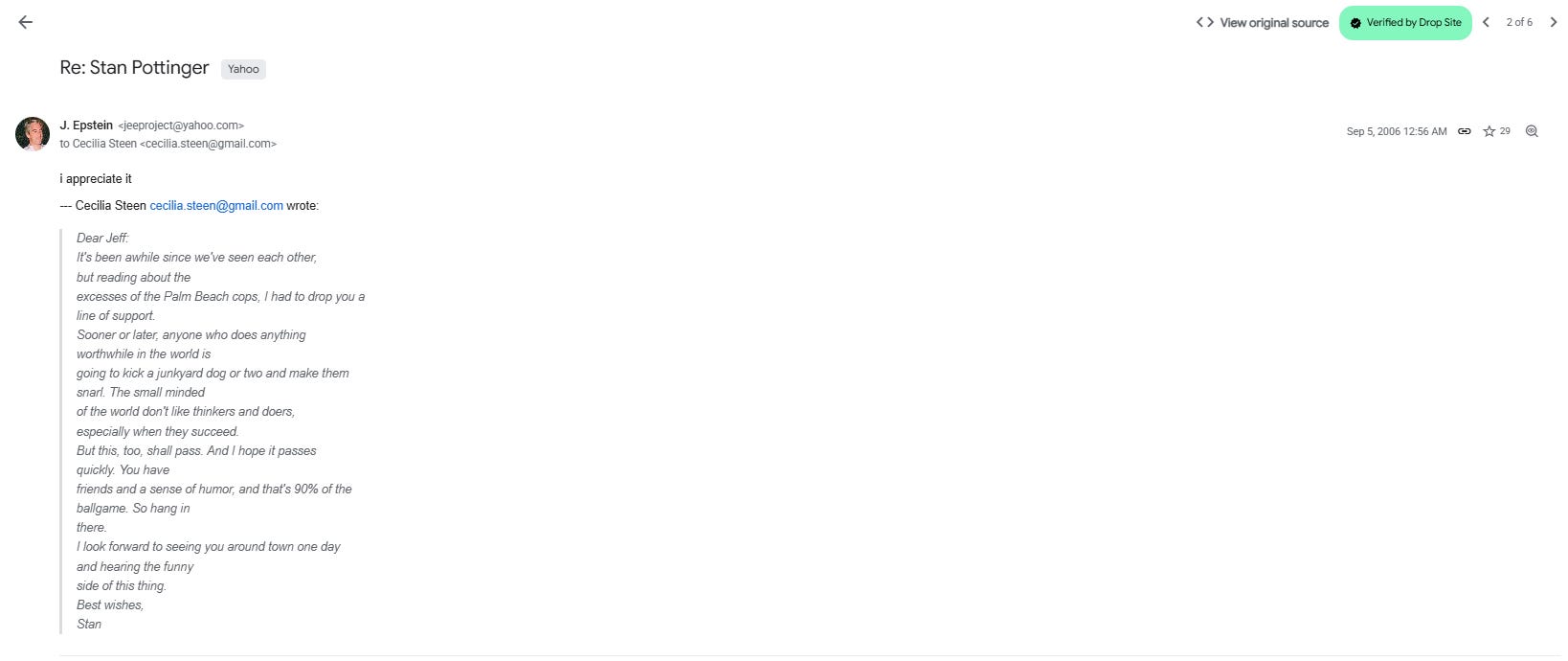
It is in the record alongside Pottinger’s documented name and his documented Palm Beach address and his documented DOJ background. The Steen/Pottinger thread is covered in full in the previous piece mentioned above. What belongs here is the observation that in 2006, while Epstein’s victims were trying to get federal investigators to take the case seriously, the men around Epstein — including his former business partner who happened to be a former senior DOJ official — were writing him letters of support and predicting things would pass.
Eight years later, in 2014, Pottinger called Brad Edwards. Edwards was already the most consequential victims’ rights lawyer in the Epstein case. He had filed the CVRA lawsuit in 2008, he had fought the NPA, he was the man Epstein had once counter-sued in a case that was eventually dismissed. The call came late at night. Pottinger offered his assistance with the litigation against Epstein. Edwards was suspicious. He later wrote in his memoir, Relentless Pursuit that he became further concerned when Pottinger mentioned he had shared an office with Epstein. Pottinger explained that they had only shared space for a few weeks and had not been in the same firm. Edwards set aside his concerns and partnered with him anyway and Edwards Pottinger LLC was born. In December 2025, the New York Times confirmed that Pottinger and Epstein had not merely shared office space but had been business partners; pitching tax-avoidance strategies together from the Hotel St. Moritz. Edwards said he was unaware of this at the time. As of February 2026, he had not responded to press requests for comment about the business relationship.
The Victims’ Lawyer
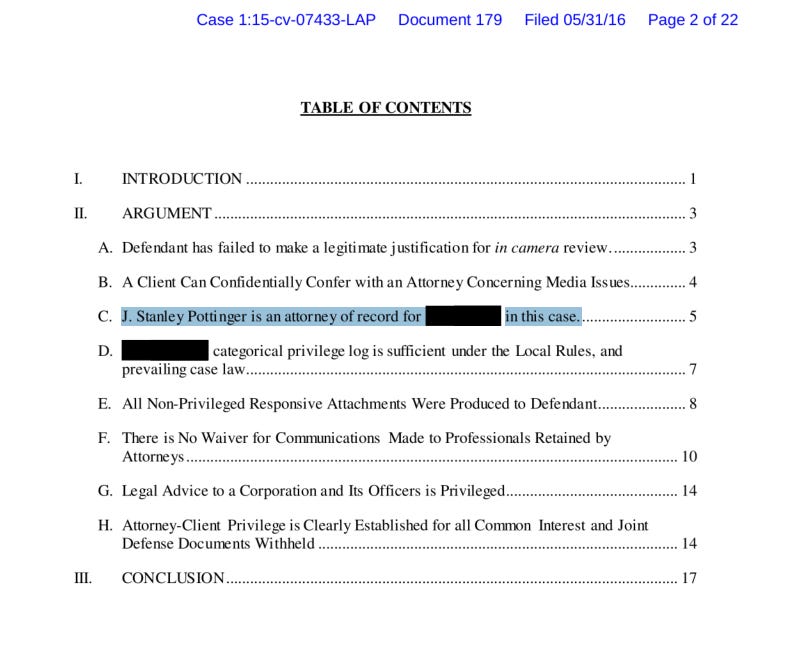
By May 2016, J. Stanley Pottinger was attorney of record for Virginia Giuffre in the case of Giuffre v. Maxwell, Case 1:15-cv-07433, in the Southern District of New York. Specifically, this is in section C of the table of contents of the plaintiff’s response in opposition to Maxwell’s motion to compel non-privileged documents, filed May 31, 2016, which reads: ‘J. Stanley Pottinger is an attorney of record for [plaintiff] in this case.’ That document is EFTA02797772.
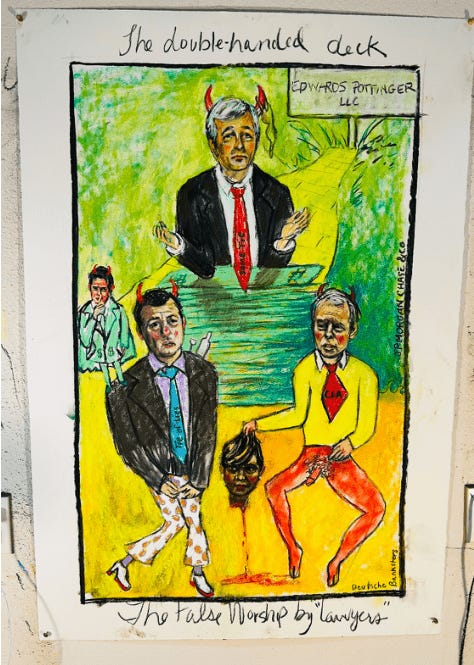
Virginia Giuffre was the most prominent survivor of the Epstein network. She had reported Epstein to the FBI in 2000. She was the plaintiff whose case eventually forced the unsealing of the Maxwell documents. Virginia died on April 25, 2025, five days after Maria Farmer submitted a 41-page evidentiary dossier to the FBI. One of those paintings in that dossier, EFTA01652481, titled ‘The Double Handed Deck/ The False Worship Of Lawyer’, depicts a devil figure at a podium labeled EDWARDS POTTINGER LLC. Maria Farmer painted this and submitted it along with more of her painting to the FBI as evidence. That is the documented record. We have also reported on that, and you can read that here.
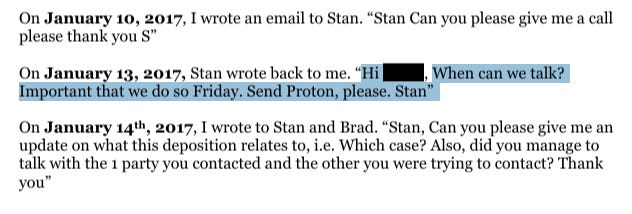
While Pottinger was serving as attorney of record for Giuffre, he was also, from October 2016 onward, in direct communication with another survivor: Sarah Ransome. Ransome had come forward in October 2016. She reached Boies Schiller through the network of Epstein survivor litigation, and it was Pottinger, not Boies, not McCawley, not Edwards, who became her primary point of contact. His first email to her said: ‘Hi. When can we talk? Important that we do so Friday. Send Proton, please. Stan.’ He asked her to use ProtonMail. This was the beginning of a relationship that would last three years, produce hundreds of documented exchanges, and end with her in a wheelchair unable to remember signing a settlement agreement.
The Hot List
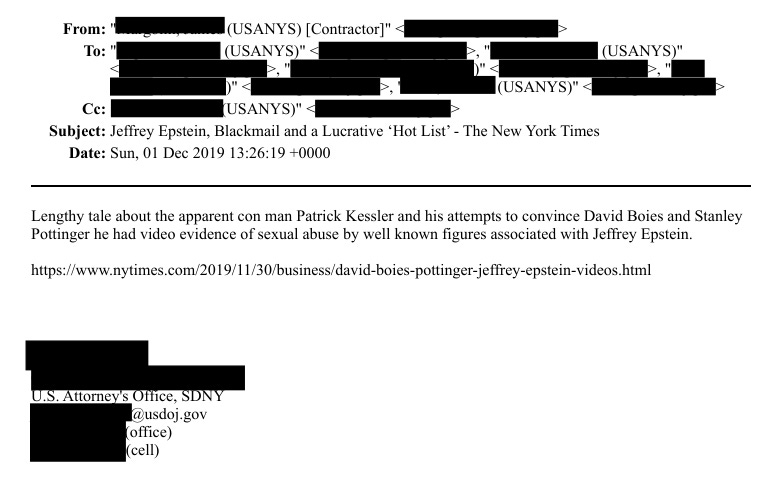
In November 2019, four months after Epstein died in federal custody, and three months after the SDNY had charged him with sex trafficking of minors, a man who called himself Patrick Kessler made contact with David Boies and J. Stanley Pottinger. Kessler claimed to have access to surveillance videos secretly recorded by Epstein at his properties. He said the videos showed powerful, wealthy men engaged in sexual activity with women at Epstein’s residences. The lawyers understood that at least some of the footage likely constituted evidence of crimes against minors.
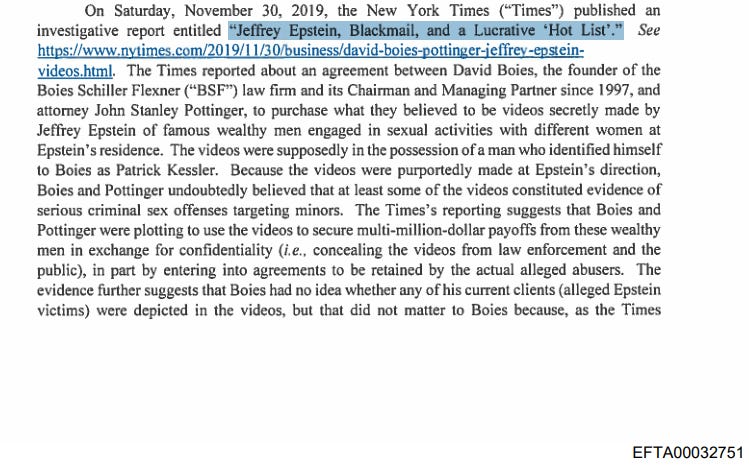
According to the New York Times’s November 30, 2019 investigation, titled ‘Jeffrey Epstein, Blackmail and a Lucrative Hot List,’ what followed was a scheme that the Times described as looking, to Kessler at least, like blackmail. Boies took the lead on the Kessler relationship, but Pottinger — independently, in texts that Boies was not copied on — drew up what the Times called a ‘hot list’ of prominent men as possible targets. He suggested in those texts that the lawyers stood to make up to 40 percent of whatever money they negotiated in private settlements. To enhance the lawyers’ leverage, Boies invited New York Times reporters to a meeting with Kessler at the BSF offices in Manhattan — on the theory that, as the Times reported, ‘the threat of a major news organization writing about the videos and confirming the existence of an extensive surveillance apparatus could greatly enhance the lawyers’ leverage over the wealthy men.’
NPR’s reporting on this story, published in March 2020, added a detail that the original Times piece had buried: Pottinger drew up the hot list independently, in texts Boies was not copied on. The scheme was Pottinger’s own initiative, operating in parallel to whatever Boies was doing. When NPR made four attempts to reach Pottinger for comment, he did not respond to any of them.
Scott Srebnick, then the defense attorney for Michael Avenatti in United States v. Michael Avenatti, put the legal framework plainly in a Brady letter he filed with SDNY on December 2, 2019 — two days after the Times published the hot list story. That letter is EFTA00032751. It stated that Boies and Pottinger had agreed to purchase what they believed to be videos secretly made by Epstein, that the lawyers believed at least some of the footage constituted evidence of criminal sex offenses targeting minors, and that the plan, as described, amounted to conspiracy to commit extortion, along with potential violations of 18 U.S.C. sections 2252 and 2252A, the federal child pornography statutes. Srebnick demanded SDNY disclose whether Boies or any member of his firm was under federal investigation for this conduct. He also asked, explicitly, that if they were not: why not?
There is no public record of SDNY ever answering that question.
What He Did to Sarah Ransome
Sarah Ransome is a survivor of Jeffrey Epstein’s trafficking network. She was recruited into the network, trafficked to Epstein’s private island, and abused repeatedly. She came forward in October 2016. She is a documented victim, her account is in the federal record across multiple court proceedings, in a sworn declaration filed under penalty of perjury, and in the EFTA archive. Her account is also detailed, specific, and supported by contemporaneous documentary evidence including email chains, medical records, a police complaint, and correspondence with multiple attorneys. This publication treats her as what the record establishes: a victim and a witness.
From January 2017 through the end of 2019, J. Stanley Pottinger was one of her lawyers. What follows is drawn entirely from the documents she filed under penalty of perjury: EFTA00145606–145642, her September 2022 grievance, and EFTA00144588–144594, her October 2023 objector declaration in the JPMorgan class action. The emails quoted below are from her own documented correspondence, preserved in the record she submitted to federal proceedings.
Pottinger and Edwards traveled to Barcelona in January 2017 to meet Ransome in person. She was in hiding, Epstein had been tracking her. The firm had already filed her civil lawsuit on January 26, 2017, before she had even signed a retainer, which she did not sign until February 24, 2017, after she had performed a deposition they needed from her for another client. The deposition was taken on February 17, 2017. The retainer was signed seven days later. As she documented: they filed her case before they were legally her lawyers, extracted what they needed, and then processed the paperwork. She wrote to Pottinger on February 21, four days after the deposition she had given for someone else’s case, scared for her life, in hiding: ‘Stan, I think you know what it’s about. Now that you guys have what you want from me, you have left me high and dry.’ He replied asking what time she wanted to talk.
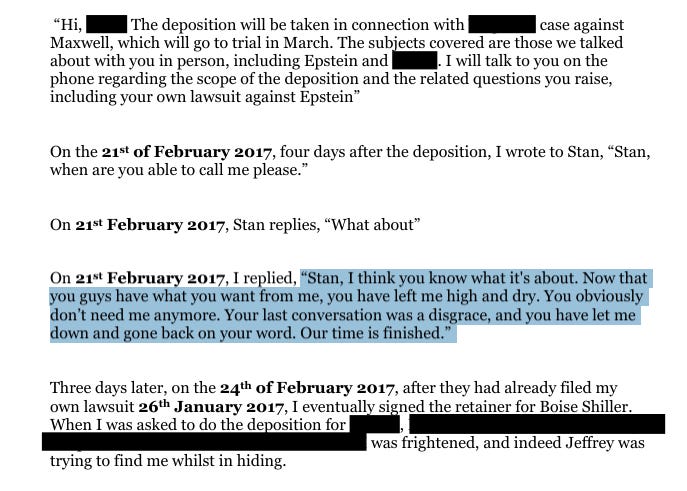
It was not finished. She stayed with the firm for two and a half more years, because as she documented, she had no real choice. They had her case, they had filed it in her name. They had her emails. By the time they asked her to hand over her email account passwords so they could access all her correspondence, she felt she had no option but to agree. She wrote later that she has no idea how long they monitored her private email accounts. That disclosure is in a sworn declaration filed in federal court.
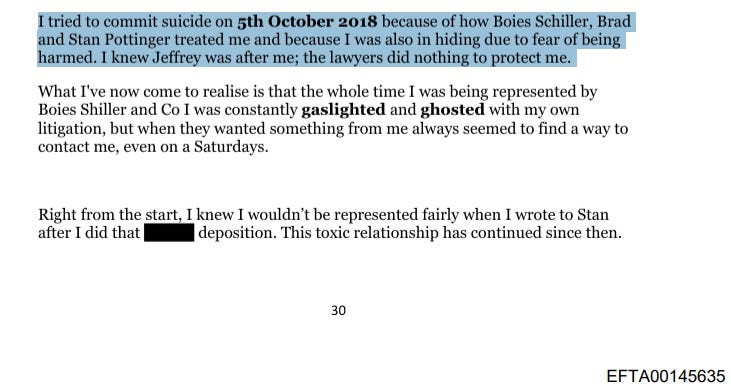
In November 2017, Pottinger called her on a Saturday morning to ask her to put her name to an op-ed in the New York Times titled ‘How David Boies Saved Me.’ He called her after weeks of silence during which she had sent increasingly desperate emails asking for any update on her own litigation. The op-ed was published on November 15, 2017, the first time Ransome publicly identified herself as an Epstein victim, giving up her pseudonym of Jane Doe 43. She wrote later that she would not have agreed to put her name to it if she had known Boies had been photographed at an intimate dinner with Harvey Weinstein and the Clintons on December 13, 2016 — less than a year before they asked her to write an op-ed rehabilitating his reputation. She described the call as pressure she could not refuse, because Boies had her case and she was desperate for any contact from her legal team. ‘I was tricked and wholly used by Boies Schiller, Brad and Stan,’ she wrote.
On September 18, 2018, during a phone call with Pottinger, he used the phrase ‘turning tricks’ to describe her. She documented it in an email to him the same day — EFTA00145637. She wrote: ‘Stan, is that what you think I was doing on my trip to Miami? Turning Tricks? I find that term not only derogatory but insulting and disrespectful to me as one of your clients. I didn’t turn tricks. I tried to survive, for your information.’
He was her lawyer and she was a trafficking survivor. He described her, during a phone call about her own litigation, as someone who had been turning tricks. There is no ambiguity in the record about what was said or who said it.
On October 3, 2018, two days before Ransome’s suicide attempt, Sigrid McCawley emailed her asking her to identify a woman from Epstein’s flight logs. On October 4, one day before the attempt, Ransome responded in full identifying the woman, describing the island, describing the relationships. On October 5, 2018, she jumped from her balcony. She broke both feet and fractured her spine. She was hospitalized for three weeks. Pottinger was copied on emails about her condition, emails from her partner Peter describing the injuries, the casts, the physical therapy she would need to walk again. He responded to one of them: ‘Thanks for the info. This is all we need on this. Hope all is going well. I don’t know these particular drugs, but I can see that the ones you are taking now are totally different from the ones you were taking before. Best wishes for a speedy foot recovery.’
In November 2018, six weeks after the suicide attempt, Pottinger advised Ransome to settle. The email is in the record: ‘We are just on the verge of racking up larger costs as the case comes closer to trial, and there will be more depositions, more travel, the retention of expert witnesses, and the like. But right now, neither side has accumulated big costs. Which suggests this is a time to settle if settlement is a possibility.’
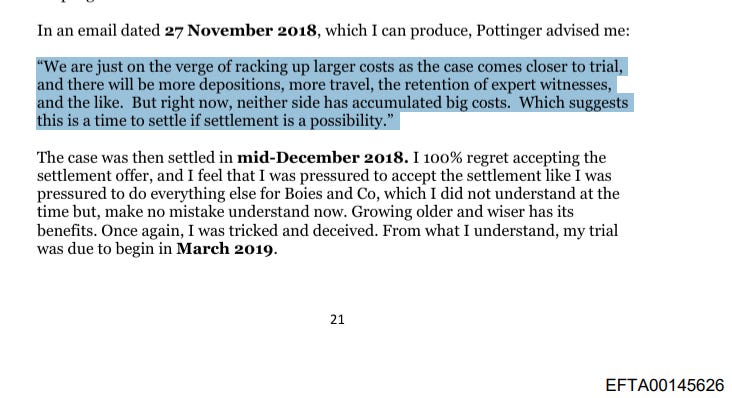
The case settled in mid December 2018. She was in a wheelchair at the time. She later wrote that she has no memory of signing the settlement agreement. She wrote: ‘I tried to commit suicide on 5th October 2018 because of how Boies Schiller, Brad and Stan Pottinger treated me.’ That sentence is in a sworn declaration filed in federal court. EFTA00145635.
On April 6, 2020, Ransome wrote to Pottinger directly, expressing her sense of betrayal. He did not respond. The documentation of the absence of a response is in her sworn record.
‘Abuser’
On October 19, 2023, Sarah Ransome filed a sworn declaration as an objector in the JPMorgan class action — Doe v. Deutsche Bank Aktiengesellschaft et al, consolidated with the JPMorgan case, Case 1:22-CV-10018/10019, SDNY. That declaration is EFTA00144588. It names J. Stanley Pottinger in paragraphs 16 through 30. It cites the New York Times hot list investigation. It asks the court directly whether it has investigated Pottinger per her prior objection. It describes him as ‘ever-present yet invisible in the Epstein scandal.’
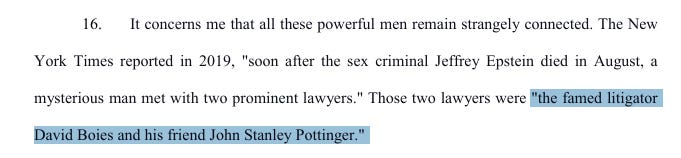
In that same proceeding, Ransome addressed the court in person. The statement she delivered is in the federal record at EFTA00143492 and EFTA00143493. She addressed the lead attorneys directly: Boies, McCawley, Edwards, and Pottinger, by name. She called Pottinger an abuser. Not in the body of a written filing, not in a footnote. She said it in open court, in front of Judge Rakoff, in a statement recorded in the federal archive.
“Your Honour, Judge Rakoff, PLEASE MAY I ASK if the court has investigated Stanley Pottinger per my request in my Objection?”
The phrase she used in her objection declaration was this: ‘abuser, in some instances, or enabler.’ That is the language of a survivor who has been unable to be more specific in a public legal filing for reasons she explained across three years of documented correspondence. It is also the language of a woman who walked into a federal courtroom and asked a sitting federal judge, on the record, whether anyone had investigated the man she had described as her lawyer.
Judge Rakoff presided, the hearing concluded. JPMorgan’s settlements were administered. Pottinger’s name was quietly removed from the Edwards Pottinger LLC website. No public statement was issued, no bar proceeding outcome was announced, no federal investigation was opened, at least not publicly. Fourteen months later, on November 27, 2024, J. Stanley Pottinger died in Princeton, New Jersey.
The Man Who Stopped the Stenographer
There is a detail in J. Stanley Pottinger’s biography that does not belong to the Epstein case directly but that tells you something important about how the man operated across his entire career. In 1977, while leading a grand jury investigation of illegal FBI break ins under the Carter administration, Pottinger questioned former FBI deputy director Mark Felt under oath. A juror asked Felt directly whether he had been Bob Woodward’s confidential source in the Watergate investigation — whether he was Deep Throat. Felt denied it, but appeared visibly unsettled. Pottinger was convinced, in that moment, that Felt was the source.
What Pottinger did next is the relevant detail. He stopped the stenographer from recording the exchange, reminded Felt he was under oath, and offered to withdraw the question, since it was outside the scope of the inquiry. Felt accepted. The exchange was not recorded. The secret held for 28 more years, until Felt confirmed his identity publicly in 2005.
This is the man who later sent encrypted messages to a hacker’s intermediary about a hot list of powerful men. The man who asked a trafficking survivor to send her email passwords so his firm could access her correspondence. This is the man who called her on a Saturday asking her to sign her name to an op-ed rehabilitating his partner’s reputation. This is the man who, when she wrote to him on April 6, 2020 telling him she felt betrayed, did not respond.
He knew, for his entire career, exactly what to stop from being recorded. And he knew exactly what to let pass without response.
The Family
On September 9, 2018, the same day an anonymous New York Times op-ed titled ‘I Am Part of the Resistance Inside the Trump Administration’ was published, setting off a Washington guessing game about its author, Jeffrey Epstein and an unidentified contact exchanged iMessages from Epstein’s personal MacBook. The device identifier is NYC024328.aff4. The email address is jeeitunes@gmail.com. The messages are in the EFTA archive at EFTA00507900-EFTA00507916.
Epstein and his contact were analyzing who had written the op-ed, discussing the NYT’s use of a trusted intermediary, and theorizing about whether a White House official had used a legal or family cutout to maintain deniability. At EFTA00507906, the contact wrote: ‘They are saying it was more than one person. Brutus has Cassius. I think it’s Pottinger and Fuentes with sanction and cut out distance by and from Kelly.’
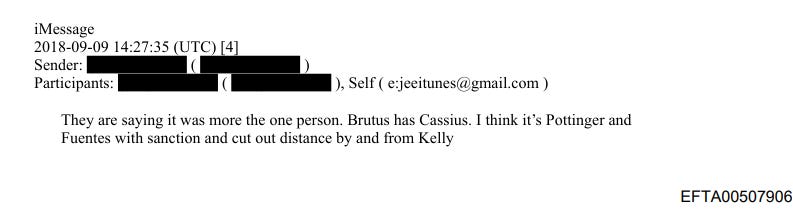
Epstein replied: ‘Coup. Pottinger? His whole family are rats.’
The Pottinger his contact was referencing was Matt Pottinger — Stan’s son, then serving on Trump’s National Security Council and who would later become Deputy National Security Advisor. The contact was speculating about whether Matt Pottinger had co-authored the anonymous op-ed. Epstein’s reply: ‘his whole family are rats’, is a comment on the Pottinger family broadly. The follow up exchange makes the connection clear: ‘His brother Stan would have written it... Pottinger’s brother (David Boies partner).’ The conversation then turns to the question of how a White House official could use a family member as a legal cutout to claim plausible deniability.
What this exchange confirms, independently of everything else in this investigation, is that Jeffrey Epstein, in September 2018, while Stan Pottinger was representing Sarah Ransome and remained attorney of record in multiple Epstein-adjacent proceedings, knew exactly who Stan Pottinger was, associated him directly with David Boies, and understood that the Pottinger family moved between intelligence and legal worlds with enough fluency to function as cutouts for people who needed deniability. What this confirms is the connection, the association, and the awareness, all in the federal record, all from Epstein’s own seized device.
What the Record Leaves Open
J. Stanley Pottinger died on November 27, 2024, without being criminally charged, without a public bar investigation, and without the court ever answering the question Sarah Ransome asked of Judge Rakoff out loud, on the record, in 2023.
What the documents show is a man who was Epstein’s business partner before Epstein became a household name, his neighbor in Palm Beach, the lawyer who wrote him a support letter after he was arrested for crimes involving children, the man who called Brad Edwards offering to help represent victims, who became attorney of record for Virginia Giuffre, who became direct counsel to Sarah Ransome, who drew up a list of powerful men whose sex tapes he believed could be monetized in texts his own law partner was never copied on, who told a trafficking survivor she was turning tricks during a phone call about her own litigation, and who advised her to settle while she was in a wheelchair with two broken feet and a fractured spine recovering from a suicide attempt she later said he helped cause.
A survivor named him an abuser in open federal court. SDNY never answered the Brady letter. His name was quietly removed from the firm website after he died. No statement was issued.
She called him ever-present yet invisible. It is, across the full length of the documented record, the most accurate description of J. Stanley Pottinger that exists.
Pottinger is a man deeply connected to the Epstein scandal who died with questions still open and the record still growing around him.
Truth is, this work takes all of us.
If this piece reached you, please share it. If you have information related to J. Stanley Pottinger, Edwards Pottinger LLC, the Kessler sex tape scheme, Sarah Ransome’s litigation, or any thread documented here, contact Last Page First. Tips can be sent privately below.
Have a tip? A lead you want to share?
Sources
EFTA00032751–32752 — Srebnick Brady letter to SDNY, December 2, 2019. Describes Boies/Pottinger sex tape scheme as conspiracy to commit extortion. Demands federal investigation. United States v. Michael Avenatti, Case No. S1 19 Cr 373 (PGG).
EFTA00143492–143493 — Sarah Ransome courtroom statement to Judge Rakoff. JPMorgan class action, SDNY. Names Pottinger abuser in open court. Asks whether court investigated him.
EFTA00144591, paragraph 30 — ‘Mr. Pottinger remains ever-present yet invisible in the Epstein scandal.’ Sworn objector declaration, October 19, 2023.
EFTA00145606–145642 — Sarah Ransome sworn grievance, September 6, 2022. Full documented account of Pottinger’s role as her counsel 2016–2019. Filed under penalty of perjury.
EFTA00507906–507908 — Jeffrey Epstein iMessage chain, September 2018. ‘Coup. Pottinger? His whole family are rats.’ ‘Pottinger’s brother (David Boies partner).’ Device NYC024328.aff4.
EFTA02797772 — Giuffre v. Maxwell, May 31, 2016. Confirms Pottinger attorney of record for Virginia Giuffre.
EFTA01652481 — Maria Farmer painting: The Double-Handed Deck. Edwards Pottinger LLC on podium. Submitted by Virginia Giuffre to FBI April 20, 2025.
EFTA00029251 — NYT hot list article circulated at SDNY, December 1, 2019.
Drop Site News, Ryan Grim, February 2026 — Epstein, Israel, and the CIA: How the Iran-Contra Planes Landed at Les Wexner’s Base. Iran-Contra, Senate Foreign Relations Committee, Cyrus Hashemi.
Wikipedia, Matt Pottinger — Deputy National Security Advisor September 2019–January 7, 2021.
Johnny Vedmore, The Pottinger Legacy, NEWSPASTE.com, February 2026.
Johnny Vedmore, The Pottinger Ultimatum, NEWSPASTE.com, 2023.
Middle East Eye, February 2026 — How Jeffrey Epstein’s Intelligence Ties Go Back Decades.
Headline USA, December 2025 — Epstein Victims’ Attorney Was Former Business Partner With Epstein.
Tommy Carstensen EFTA tracker — Pottinger: 2,011 documents, July 2010–May 2025.
© 2025-2026 Last Page First. All rights reserved.
This society has been invaded by Predators. It’s a horror story that is unending. Greedy narcissistic men who literally become toxic cancers feeding off women and children.
Thank you for your hard work Jana.
Great dig, Jana.